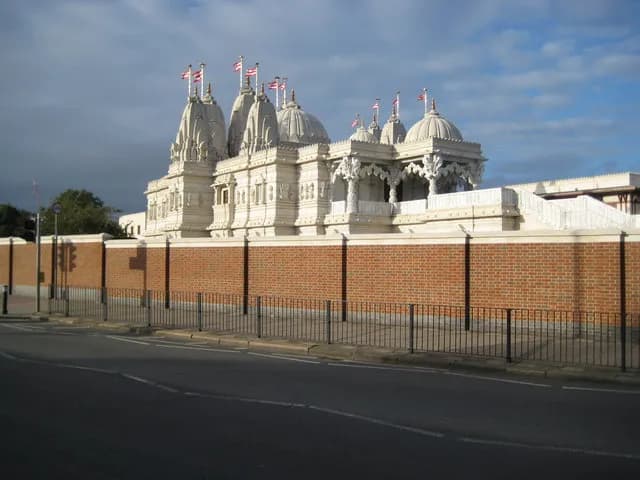
In August 1995, a former industrial site in Neasden became home to a landmark that would transform both the skyline and the cultural identity of Brent. The BAPS Shri Swaminarayan Mandir, built entirely from stone without structural steel, stands as Europe's first traditional Hindu temple constructed according to ancient Vedic architectural texts.
From Concrete Foundation to Marble Sanctuary
Planning permission for the temple was granted in August 1992, and construction began three months later. The foundation stone was laid on 24 November 1992, when 4,500 tonnes of concrete were poured in 24 hours; at that time, this constituted the largest concrete pour in British history.
The temple's materials arrived from three continents. The exterior comprises 3,000 tonnes of Bulgarian limestone, whilst the interior features 1,200 tonnes of Italian Carrara marble and 900 tonnes of Indian Ambaji marble. In total, more than 26,300 stone pieces were carved by over 1,500 artisans working across fourteen sites in India, including workshops in Uttar Pradesh, Gujarat, Maharashtra, Rajasthan and Bengal. The largest piece weighs 5.6 tonnes; the smallest, 50 grams.
The stones travelled 3,900 miles from Bulgaria and 4,800 miles from Italy before continuing 6,300 miles to London. No structural steel was used in the main temple; the load-bearing structure follows the Vastu Shastras, ancient Vedic architectural texts. Craftsmen assembled the pieces like a "giant three-dimensional jigsaw puzzle" over two and a half years.
Design and Dimensions
The mandir rises 21 metres high, extends 60 metres in length and spans 22.5 metres in width. Seven shikhars (spires) and six gummats (domes) crown the structure, supported by 193 sthambhas (pillars). The central dome, inspired by the Delwara Jain Mandir at Mount Abu in Rajasthan, reaches 10 metres in height and 8.5 metres across, with a keystone weighing 2.5 tonnes.
The interior sanctuary features milky-white Carrara and Ambaji marble. The garbh-gruh (sanctum sanctorum) contains gilded sinhasans, throne-like canopies. Modern provisions include under-floor heating, a lift for disabled visitors and two marble staircase fire exits.
Adjacent to the stone mandir stands the Haveli, a cultural centre built in the traditional Gujarati haveli style of the 17th century. British architect Nigel Lane designed this wooden structure, which incorporates Burmese teak from sustainable forests and English oak. The construction used 226 oak trees, with 2,300 saplings planted in Devon as compensation. The Haveli includes a pillarless prayer hall with capacity for 3,000 people, plus a gymnasium, medical centre and dining facilities.
Spiritual Leadership and Community
BAPS (Bochasanwasi Shri Akshar Purushottam Swaminarayan Sanstha) built the temple under the spiritual guidance of Pramukh Swami Maharaj, who inaugurated the mandir in 1995. The organisation's current spiritual head is Mahant Swami Maharaj. Yogvivekdas Swami serves as head swami for the UK and Europe, whilst Sanjay Kara acts as trustee for BAPS UK and Mr Jitu Patel chairs BAPS Swaminarayan Sanstha UK.
The temple complex occupies 1.5 acres and includes a 550-space car park. The gardens, designed in parterre style at the front and sides with a formal garden at the rear, won Brent in Bloom awards in 2009, 2010 and 2012, plus a London in Bloom Certificate of Excellence in 2009.
Royal Recognition and Public Access
The temple has received sustained recognition from the British establishment. King Charles III, then Prince of Wales, first visited in 1996 and returned in 2001, 2009 and October 2025. The 2025 visit, accompanied by Queen Camilla, marked the temple's 30th anniversary. During the 2024 general election campaign, Prime Minister Rishi Sunak and his wife Akshata Murty visited on 29 June 2024. Sunak described the temple as "a shining example of how to inspire a generation of young people to volunteer and support their community."
King Charles III has previously noted that the temple "serves the local community as a place of worship, learning, celebration, peace and community service."
The temple remains open to people of all faiths throughout the year, with free admission. Darshan viewing hours run from 9:00 to 11:00, 11:45 to 12:15 and 16:00 to 18:00, with weekend and bank holiday hours starting at 15:30. The Abhishek ceremony takes place from 9:30 to 12:00 and 16:00 to 18:00. An exhibition on Hinduism occupies 3,000 square feet and includes 3D dioramas and documentary materials. School visits and group tours operate by appointment.
Community Service in Brent
BAPS Charities operates extensive programmes from the Neasden temple. During the Covid-19 pandemic and subsequent winter hardship periods, volunteers prepared and distributed thousands of hot meals and hampers to vulnerable residents across Brent and beyond.
The charity partners with The Felix Project for surplus food redistribution and collaborates with Women of the World (WoW) on community initiatives. An annual BAPS Charity Challenge raises funds for educational and community programmes. The temple participated in the Great British Spring Clean in March 2024 and marked International Women's Day the same month.
Between 1992 and 2021, The Swaminarayan School operated opposite the temple as Europe's first independent Hindu school. In 2007, its GCSE results placed fourth among all independent schools in the United Kingdom.
Recognition and Awards
The temple has received multiple honours acknowledging its architectural and community significance. In 1996, it won the Most Enterprising Building Award from the Royal Fine Art Commission and BSkyB. The Natural Stone Award followed in 1995 from the Stone Federation. Time Out listed it among the "Seven Wonders of London," whilst Reader's Digest included it in "70 Wonders of the Modern World" in 1998. The temple received the UK Pride of Place Award in December 2007 and a TripAdvisor Travellers' Choice Award in 2024. In 2000, Guinness World Records recognised the temple for serving 1,247 vegetarian dishes during an Annakut celebration.